When the US told Ukrainian President Volodymyr Zelensky that they could get him out of Ukraine, he replied:
“I need ammunition, not a ride.”
US official confirmed Ukraine President Volodymyr rejected an offer from the American government to evacuate Kyiv.
A senior American intelligence official with direct knowledge of the conversation quoted the president as saying that “the fight is here” and that he needed anti-tank ammunition, “not a ride.”
Volodymyr Zelensky is just one of many many Ukrainians who are standing up to defend their country. Members of parliament, public servants, athletes, men as old as 60 years old, and as young as 18 years old.
Among them are the Klitschko brothers. These two brothers are former world boxing champions.
Vitali Klitschko, the former WBC heavyweight world champion took up arms to fight for his country. By his side is younger brother, Wladimir, a former unified heavyweight champion. Wladimir became the major of Kyiv, the Ukrainian capital, after boxing. He is defending Kyiv.
Dozens have already died and more than 100,000 are fleeing.
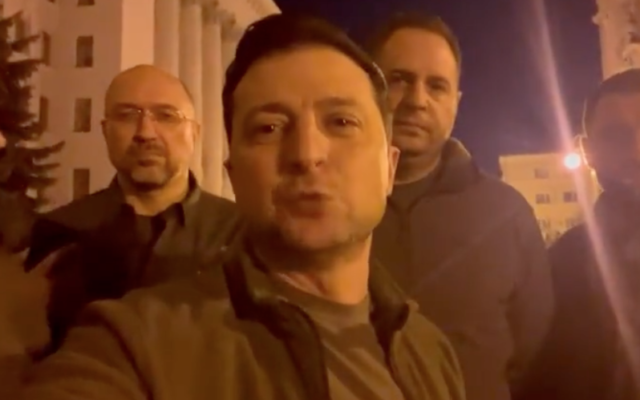
Zelensky’s whereabouts were being kept secret after he told European leaders in a call Thursday that he was Russia’s No. 1 target — and that they might not see him again alive again. His office later released a video of him standing with senior aides outside the presidential office and saying that he and other government officials would stay in the capital.
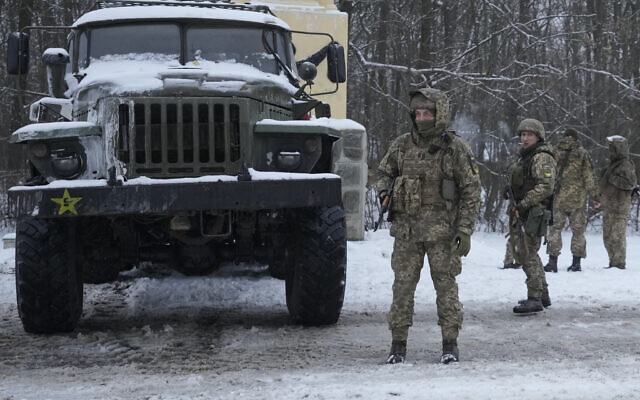
Ukrainian servicemen stand by a deactivated Russian military multiple rocket launcher on the outskirts of Kharkiv, Ukraine, on Friday, February 25, 2022. (AP Photo/Vadim Ghirda)
Ukraine President Volodymyr Zelensky posts a video of himself and his team outside the presidential headquarters in Kyiv, on February 25, 2022. (Screenshot/Twitter)
The Ukrainians are putting up a very spirited fight, but in the long run, Russians are better equipped and have advanced artillery.
Putin expected a swift victory, but met a much better prepared Ukrainian fighters than in 2014 when he invaded and occupied Crimea and Donbas.
The fighting has reached Kyiv, and Ukraine may fall. But when we remember the Russian-Ukrainian war, let’s remember this:
That Russia invaded Ukraine without provocation. And ordinary Ukrainians picked up arms and defended their country to their deaths.
Why did Russia invade Ukraine in February 2022, and not two years ago, or February 2021, or earlier between 2016 – 2018?
After all, Putin was as evil in 2014, when Russia invaded and annexed Crimea and Donbas, as he is now. These two regions were part of Ukraine. Russia waited until February 2022, to conduct a full scale invasion of Ukraine.
The two possible reasons lie in US President Joe Biden’s two fold decisions to withdraw from Afghanistan and stop drilling of sale gas in the US.
Afghanistan
The US withdrawal in Afghanistan was chaotic and messy. Even the liberal media outlets like CNN couldn’t believe the abrupt withdrawal of US troops, which left their Afghanistan allies vulnerable to slaughter from the Taliban.
Everyone agreed that US should leave Afghanistan. But the rushed manner in which it was done revealed Biden didn’t understand the Middle East. He admitted later that he didn’t expect Taliban to move in so fast. Women, children, and Afghans who assisted US soldiers, and US marines died in the process.
Putin watched the unwillingness of Biden to help allies and partners when Afghanistan was left without help. He knew Biden wouldn’t be counted on to help Ukraine.
Oil & Gas
Even now, the sanctions of US and EU against Russia doesn’t include Russian export of oil & gas to EU.
This is the most absurd exception because we all know that Putin’s war machine is primarily driven by the oil and gas industry. But it’s also understandable. In that if US and EU target the oil and gas sector of Russia, it will plunge Europe into darkness because EU relies on Russian oil! Especially Germany. And EU is nothing without Germany.
You would think Putin had calculated that into the equation before invading Ukraine in February 2022.
What is Biden’s role in this?
When Biden became president in 2020, he inherited a US oil and gas industry that had become “net-exporter” by 2020.
Essentially US had sufficient oil & gas from its own drillings, that it exported the surplus. The sale gas industry was booming.
Biden shut this down. If this was in operation, US would have supplied Europe, and sanctioned Russian oil and gas.
Biden’s push for eliminating sale drilling in the US had to do with climate change concerns. But it’s ironic that EU is still using climate-destroying oil and gas from Russia. Even the US continues to import oil from the Middle East.
And more importantly, US and EU cannot sanction Russian oil & gas because EU relies on this “dirty” source of electricity.
In summary, Putin saw an opportunity to attack now. Because Biden has created the opening.
There may be more, but going by media reports since 2020, three Australians have broken PNG laws, and have waked free. A combination of outdated laws, and police negligence have helped.
The first case involved an Australian pilot who crashed an aeroplane at the outskirts of Port Moresby. He was attempting to fly 500kg of cocaine out from Port Moresby when the plane crashed.
The PNG Drug Act 1952 doesn’t list cocaine as illicit or illegal. The Australian pilot was not charged for the drugs. He was only charged for illegally entry: entering PNG without a passport.
In the same month (26 July), the Australian Federal Police website reported that 36-year-old New South Wales man was arrested at Atherton for drug trafficking. He was charged with:
Conspiracy to import commercial quantities of border controlled drugs., contrary to Section 307.1(1) and Section 11.5(1) Criminal Code Act 1995 (Cth);
Providing material support or resources to a criminal organisation, contrary to section 390.41 Criminal Code Act 1995 (Cth).
The maximum penalty if convicted of these offences is life imprisonment.
The difference between PNG & Australian laws on drugs cannot be more clearer than these two cases.
Then in November 2021, police discovered a methamphetamine (meth) laboratory at the Sanctuary Hotel in Port Moresby. The man was not charged with drug offences because the Drug Act doesn’t account for meth. He was, however, charged with the illegal possession of weapons. Police described the outdated drug laws as a “slap in the face” given the resources and time put into investigating, “yet we cannot take it to the court process”
Source: ABC
According to Section 37 (2) of the PNG Constitution, a person cannot be charged for an offence not provided by law. In essence, this lengthy provision was interpreted by the Supreme Court of PNG as:
“The fundamental proposition is: nobody may be convicted of an offence that is not defined by, and the penalty for which is not prescribed by written law. (SC REF NOS 2, 3 & 5 0F 2014).”
Who should be blamed for criminal cartels walking free in PNG?
The answer will surprise some of you. The blame lies squarely at the feet of PNG politicians. According to sections 99 and 100 of PNG Constitution, on the MPs can repeal, amend or make laws. If the MPs don’t do their jobs, no one else will.
You have been led to believe that the MPs are project managers, service deliverers and in some cases, even seen as walking ATMs. That is simply not their job.
The third case was a result of police negligence, or ignorance. Whether they were not educated in the matter is anyone’s guess.
Sean Honey, an Australian, was arrested for six counts of weapons possession and one count of cannabis possession. The court found that police used the wrong form to search his premises. Instead of Form 3, police used Form 4 to conduct the search. As per Search Act 1977, and Search Regulations 1977, Form 3 shall be used for such searches.
According to former Commissioner and current Secretary for Law Reform Commission, about 370 PNG laws are outdated by at least a century, and are of no practical use in the modern age.
But instead of debating, repealing and amending these laws, MPs are busy delivering services in their respective provinces. Instead of performing their law making duties, they adjourn Parliament to avoid votes of no confidences. They descend into two camps, and every end of the grace period, hoping to be the ones to get into the lucrative government side so they can have their hands on the state coffers.
For 2022, ask you MP, what is your main role as a representative of this electorate?
If he says “service delivery”, chase him out of your village. He doesn’t know his job.
Jane Marczewski, who went by the stage name Nightbirde, won the golden buzzer at the 16th America’s Got Talent show in 2021. And she performed whilst fighting cancer.
When she said she would sing an original, a song she wrote about herself titled “It’s Okay”, one of the judges asked if the song had a deeper meaning.
Nightbirde revealed she was fighting cancer. “Last time I checked, I had some cancer in my lungs, my spine, and my liver,” she told the audience.
She added: “You can’t wait until life isn’t hard anymore before you decide to be happy.”
The opening versus goes:
I moved to California in the summertime….I changed my name thinking that it would change my mind… I thought that all my problems they would stay behind…I was a stick of dynamite and it just was a matter of time.
Simon Cowell pressed the golden buzzer.
After the Golden Buzzer Nightbirde said she had only a two-percent chance of surviving. But, in the same spirit that allowed her to shine, she shared:
“Two percent is not zero. Two percent is something.”
As her health deteriorated, Nightbirde withdrew from the AGT contest. By then her audition reached more than 200 million views on YouTube.
Jane ‘Nightbirde’ Marczewski passed on, on 19 February 2022.
Jane had just 2% survival, but she gave us her best. A song we could listen to over and over again. May we be inspired to give our best.
From 17 to 21 January 2022, the Registry of Political Parties & Candidates, with the support of donors, ran a “mentoring” program for aspiring female candidates to contest the 2022 national election. Getting women into parliament is tough in PNG.
There were only seven women elected to PNG parliament in its 46 years of independence, with only two getting re-elected after their first term. Currently there are no women in its parliament.
Conversations around lack of women representation in parliament, however, often revolves around financial constraints, violence during elections, corruption and bribery, and cultural preference for male leadership, among other things.
There are lessons to be learnt from the experiences of women who won the election, and those who were re-elected after the first term. Here were document our conversations with two former female MPs who were re-elcted after the first term to the PNG parliament, and one female MP from the Bougainville parliament who won an open seat contesting against male candidates.
Before she passed away in 2020, one of us had the chance to talk with Nahu Rooney. Nahu Rooney was one of three women elected to the PNG parliament after independence in 1977, and held ministerial portfolios for correctional services and justice during her two terms as MP for Manus. She also co-founded the People Democratic Movement, which produced former prime ministers Pias Wingti and Mekere Mourata.
We also had the chance to have Dame Carol Kidu speak to the University of Papua New Guinea students in an event organised by the Political Science Students Association in 2021. Kidu represented the Port Moresby South electorate for three terms (1997-2012), holding senior ministerial portfolios, as well as leading the opposition at one point.
Also in 2021, one of us interviewed Hon Theolina Roka Matbob, who is the only female to win an open seat in the 2020 Bougainville election, and is serving as the minister for education. The other three women in the current Bougainville parliament contested the three reserved seats for women.
From our conversations with all three women, it was clear that they lived with the communities, and they had huge support from men in their communities.
Theolina Roka Matbob, for instance, spent the seven years before 2020 Bougainville election in Loro Constituency, running adult literacy and counseling programs for those affected by the crisis 10 years civil war. She and her husband Nathan Matbob also took on the fight to hold Rio Tinto accountable for the environmental destruction by its former Panguna mine. She told us it was the men who asked her to contest the election, and they led her campaign.
It is the same story with Nahu Rooney. Before the 1977 election, was organising the Manus bureaucracy into a modern provincial system (following the 1976 reform that created provincial governments). Leading up to the 1977 election, 13 ward councilors asked her to contest the first national election. The menfolk led her campaigns.
Dame Kidu’s first election was a bit different. She attribues her first success in the 1997 election came to “sympathy votes”. The people wanted her husband Buri Kidu, who was the first national Chief Justice, to contest the election, but he passed away before the 1997 election. So when she contested the election, the people voted her out of sympathy for her husband. She used the first term to consolidated her political support for the next two years.
The other aspect common to these women MPs experiences were the role of men. The role of men in the success of female candidates expands beyond their traditional role as spokesmen and decision makers in most PNG societies. During elections, young men travel long distances to campaign for their candidates. Even if you account for violence, the rough terrains and lack of road networks makes it difficult for women candidates. Male support is crucial for female candidates.
The support of men in general was crucial, but their husbands in particular played an important role. As one women leader in Port Moresby pointed out to us, all three women who won in the 1977 election had expatriate husbands or partners. This may not be important now, but back in the 1970s, the expatriate community was perceived to have somewhat higher status and influence, and was also better resourced. Dame Kidu’s husband (a Papua New Guinean) was held in high regard as the first PNG Chief Justice. The status and resources of their husbands must have helped these female MPs.
On getting re-elected, insights we gained from Dame Kidu are worth mentioning. In her first term as MP for Port Moresby South, her colleagues wanted to lobby for her to be given a ministerial portfolio but she refused. She did not want the ministerial responsibilities to keep her away from her constituency. However, she chaired one of the parliamentary committees, and had a lot of media spotlight for her work as chairperson of the committee. She used the first term to consolidate political support in her constituency.
Ministerial portfolios are demanding. They require the minister’s presence in Port Moresby where all government departments and central bureaucracies are located. For ministers representing constitutencies outside of Port Moresby, ministerial responsibilities keep the MPs in Port Moresby and this frustrates their constituencies.
It is important to note that in PNG, voters support MPs based on local issues and benefits. So even if the minister does a good job at the national level, she can remain unpopular in her constituency.
There were three female MPs elected to PNG parliament in 2012, but all lost in 2017. Two of these MPs were given ministerial portfolios in their first term. It is not clear to what extent the ministerial duties of the two MPs impacted on their failure to get re-elected. Russel Yangin’stwo articles delves into possible reasons why the three female MPs may have lost in 2017 (see here andhere).
The proposals for reserved seats may not be ready for the 2022 elections. Even if passed, these proposals will be temporary. Lessons from successful female candidates are useful female candidates in the future.



 Academia Nomad